Portuguese version: Read the original article in Portuguese
Ever since IIBA adopted “Enabling Confidence” as its theme for this year, I have found myself thinking about it. English is not my native language. My deepest thoughts happen in Portuguese, and sometimes certain words simply don’t translate cleanly from one language to another.
Portuguese doesn’t have distinct words for trust and confidence. Some dictionaries translate trust as “credibilidade” (credibility), but that doesn’t quite capture the meaning either. After all, complete strangers can earn our trust with nothing more than a warm smile and an honest-looking face.
The Portrait Hidden in the Attic
In The Picture of Dorian Gray, Oscar Wilde explores the idea that we judge a person’s trustworthiness by their appearance. Envy, resentment, hatred, and cruelty leave visible marks on a person’s face. They become scars that others can see and interpret.
Except for the young and handsome Dorian Gray. He commits terrible acts, yet his face remains youthful and angelic. Only the portrait hidden away in the attic reflects the corruption of his soul.
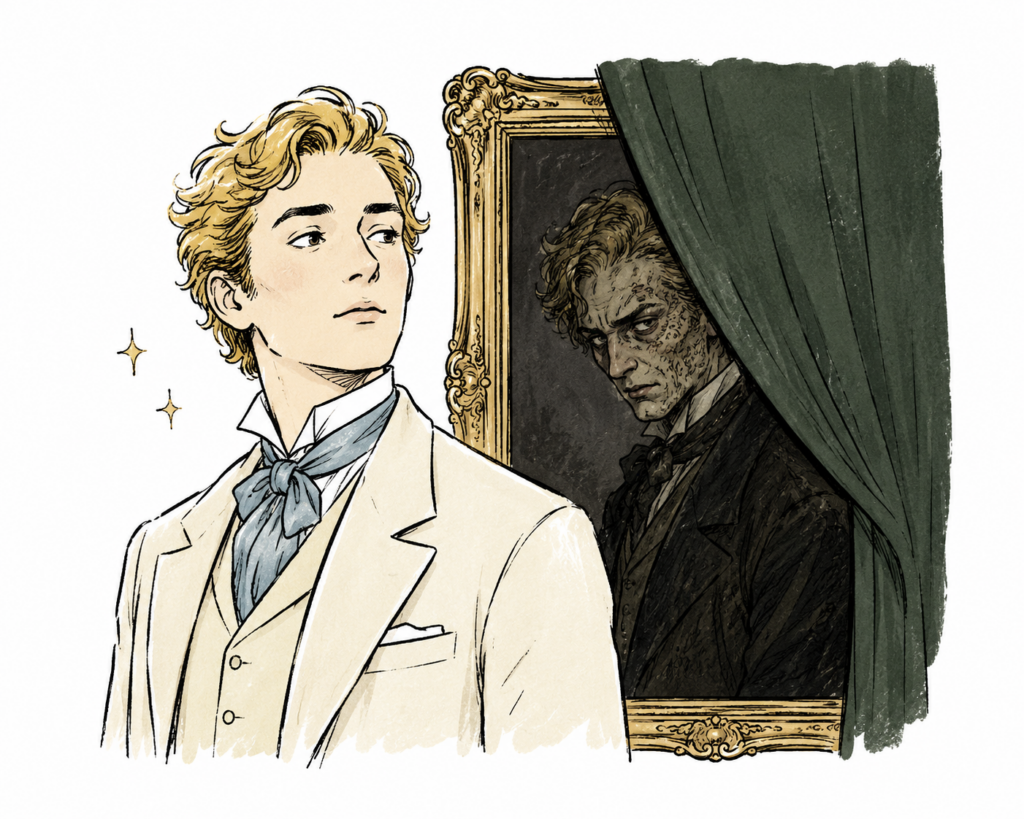
The problem is that, in the real world, there isn’t always a portrait hidden in the attic revealing who someone truly is. And that applies not only to people, but also to organizations and AI systems.
When we place our trust in someone, we delegate responsibility and accept risk. We do this constantly.
I trust the airline pilot flying my plane.
I trust my doctor.
I trust the bank that holds my money.
I trust my insurance company.
I trust the website where I pay today for something that will only arrive several days later.
Trust is the foundation of human relationships. In many ways, it is the foundation of society itself.
Disclaimer: I don’t trust politicians very much, but that’s a different discussion.
Trust Is Not the Same as Confidence
One of the joys of learning a new language is that it doesn’t merely give us new words for existing ideas. It expands the range of concepts we can think about.
Confidence is related to our level of certainty regarding a future outcome.
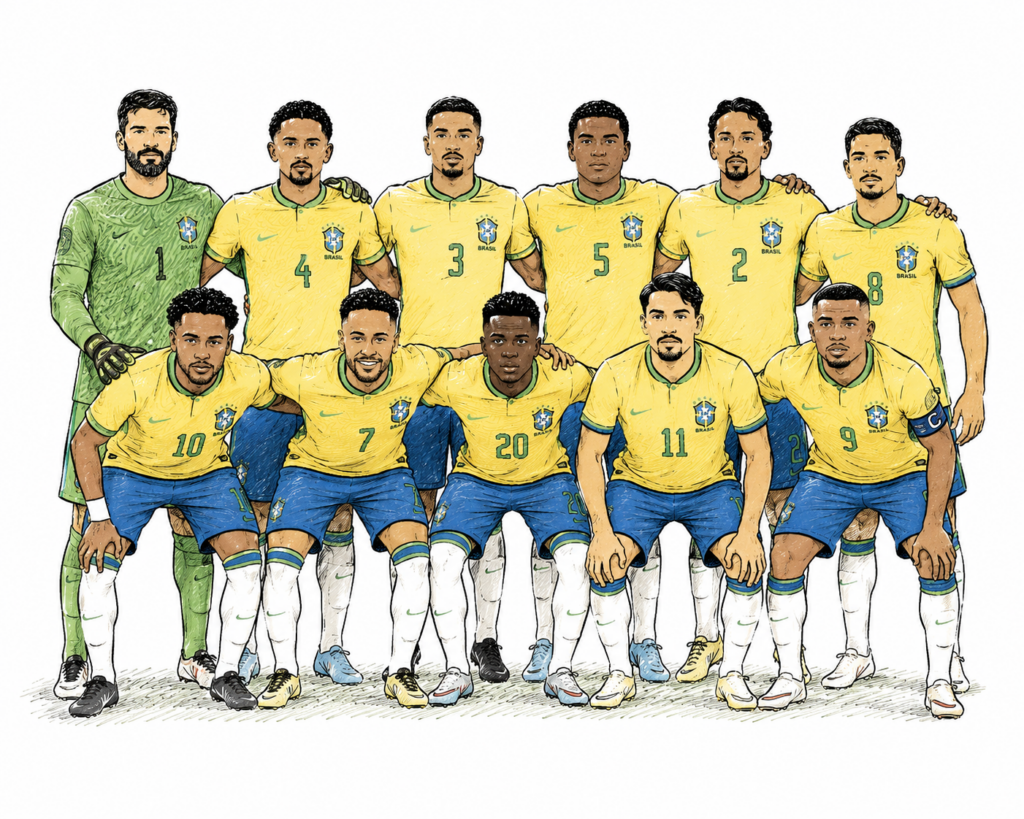
Do you believe Brazil has a chance of winning the next World Cup?
How confident are you?
My answer would depend on factors such as the team’s recent performance, the number of goals scored, the players’ physical condition, and even their psychological readiness.
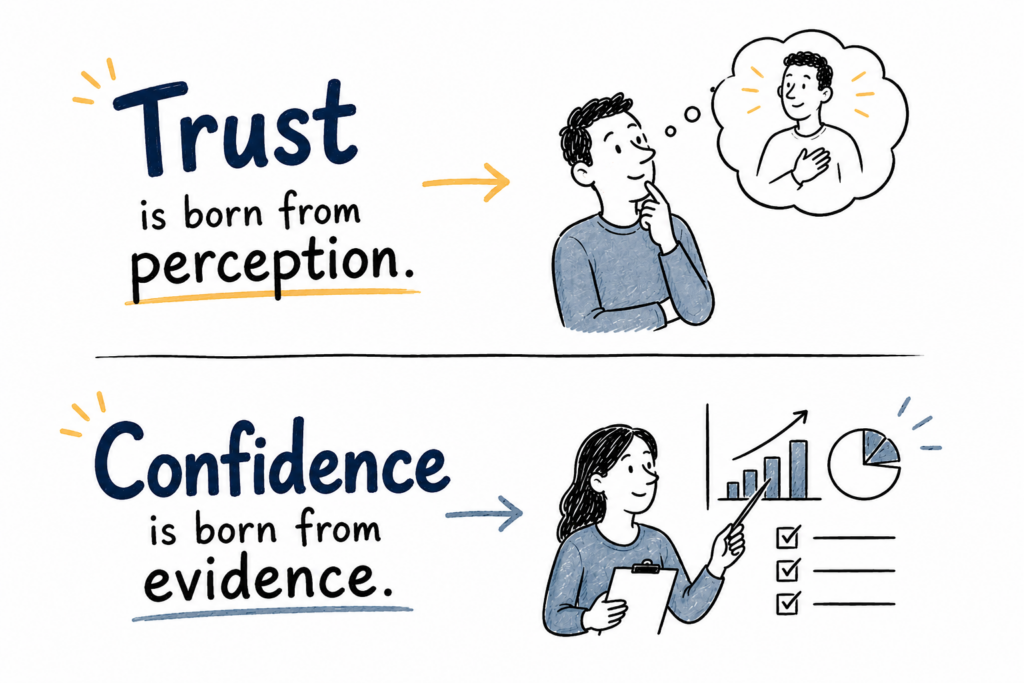
- Trust is granted based on our perception of intentions, integrity, honesty, character, and alignment of interests.
- Confidence is built on evidence of consistent performance and predictability.
The distinction is subtle, but important.
In practice:
- Trust asks: “Do I believe you will do what I think is right?”
- Confidence asks: “Do I believe you can deliver the expected outcome?”
What Should We Do Based on Trust and Confidence?
The figure below presents four quadrants based on how we assess people and organizations through these two lenses.
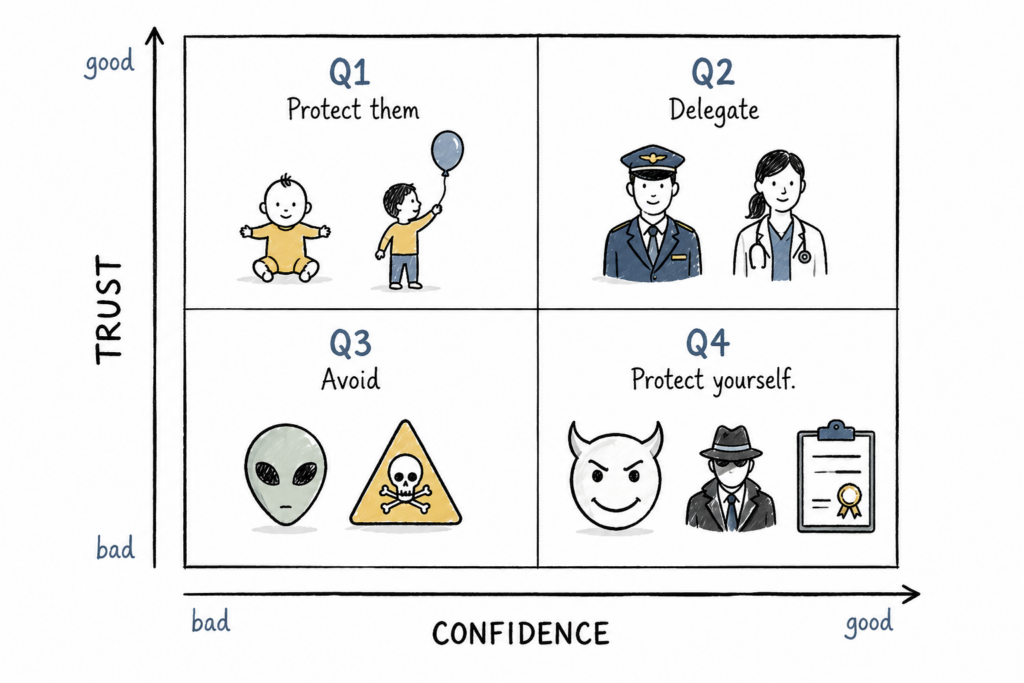
Q1 — High Trust, Low Confidence
These are people whose intentions I trust, but whose skills are still developing.
My children when they were young. Interns. Junior employees. A customer who just purchased a sophisticated product and doesn’t yet know how to use it.
My strategy here is simple: Protect them.
Guide them. Create safeguards. Put training wheels on the bicycle until experience and learning allow them to move into the next quadrant.
Q2 — High Trust, High Confidence
These are the people in whose hands I would comfortably place my life.
The airline pilot. The doctor. My lawyer.
Of course, each within their area of expertise. I would not ask my doctor to fly an airplane. A medical degree does not qualify someone to do that. But when it comes to my health, I believe their years of study have prepared them well, and from the way they conducted the consultation, I felt they were genuinely interested in my well-being.
Q3 — Low Trust, Low Confidence
I don’t want to spend much time discussing this group. These are the people I consider both incompetent and ill-intentioned.
They want my money and have little interest in delivering value.
My recommendation is straightforward: Avoid them.
Q4 — Low Trust, High Confidence
This is perhaps the most interesting quadrant.
I may suspect that these individuals or organizations are more focused on their own interests than mine, yet I recognize that they are exceptionally capable. Sometimes they are the very best at what they do.
That makes me willing to work with them, but carefully.
Relationships in this quadrant require contracts, clear rules, explicit commitments, and consequences for non-compliance.
In other words: Protect yourself.
This is how banks deal with borrowers. The bank may believe the borrower is capable of repaying the loan, but it still demands collateral and contractual protections.
And What About AI?
We are still developing our levels of trust and confidence regarding AI-based solutions.
With systems such as ChatGPT, Gemini, and Claude, we are discovering something fascinating: AI can deliver hallucinations with remarkable confidence. Sometimes it sounds so certain that we end up believing complete nonsense.
Just as we evaluate doctors and pilots differently depending on context, we will need to evaluate AI systems differently as well.
Q1 — High Trust, Low Confidence
An internal AI solution running locally within my organization and trained on my own data.
I trust it because it operates under my control. However, it still requires testing and experimentation before being used broadly.
Example: an AI-powered service desk assistant.
Q2 — High Trust, High Confidence
Robust AI solutions that have been thoroughly validated and are ready for large-scale deployment.
Example: biometric identity verification systems.
Q3 — Low Trust, Low Confidence
The magical AI vendors who appear daily in my spam folder promising revolutionary results.
No references. No track record. No evidence.
I don’t think I need to provide examples. Just check your spam folder.
Q4 — Low Trust, High Confidence
An AI solution that performs extremely well, but whose provider still leaves me uncomfortable regarding how my data might be used, retained, or shared.
Or perhaps a provider on whom I fear becoming excessively dependent.
Why Does This Matter?
Perhaps everything I have written here seems obvious. Maybe I am simply pointing out that bananas are different from apples.
Yet even among native English speakers, I have found that this distinction helps people think more clearly about relationships, risk, and decision-making.
When it comes to AI, we must learn how to evaluate performance in order to establish the appropriate level of confidence for each application we choose to adopt.
And I would not be surprised if every major AI company has its own version of Dorian Gray’s portrait hidden somewhere in the attic.
When purchasing AI services, make sure responsibilities, SLA (service levels agreement), governance mechanisms, and accountability are clearly defined.
Where Business Analysis Fits In
IIBA often explains how it helps Business Analysis professionals develop the confidence needed to perform their roles through knowledge, certifications, community, and continuous learning.
I completely agree. I have personally benefited from all of these opportunities and recommend them to anyone in the profession.
But I would like to take the conversation a step further.
Beyond helping ourselves, how can we help our organizations and stakeholders?
As Business Analysis professionals, I believe we are responsible for creating conditions in which:
- Confidence can be evaluated through evidence, metrics, experimentation, governance, and transparency.
- Trust can grow through clear communication, aligned expectations, and well-defined objectives.
I often argue that Business Analysts need to become less operational and more strategic.
Perhaps consciously working with both trust and confidence is one way to make that transition.
Because in a world increasingly mediated by algorithms, AI, and automation, our primary responsibility may not be to provide answers.
It may be to create the conditions that allow people and organizations to make decisions with confidence.
Trust may be granted.
Confidence must be earned.
Coming Next
I will be spending quite some time exploring this topic as I prepare a keynote titled “Enabling Confidence in the AI Era”, which I will be presenting in São Paulo, Warsaw, and Sarajevo soon.
I still have many ideas to develop and refine. So I’d love your help.
Do you agree with this distinction? Have you found it useful in your own work? Or do you see things differently?
Leave a comment and let me know.
In the next article, we’ll explore a topic even closer to how most people understand confidence: Self-confidence.
References
- Enabling Confidence: Preparing Business Analysis Professionals for What’s Next
- What is Business Analysis?