Artificial Intelligence is transforming the way organizations build products, automate processes, and make decisions. As AI-powered tools accelerate software development and generate solutions at unprecedented speed, one question becomes increasingly important: who ensures that organizations are solving the right problems?
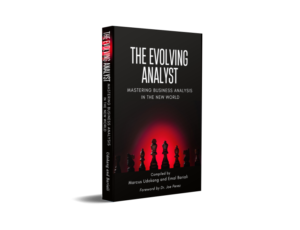
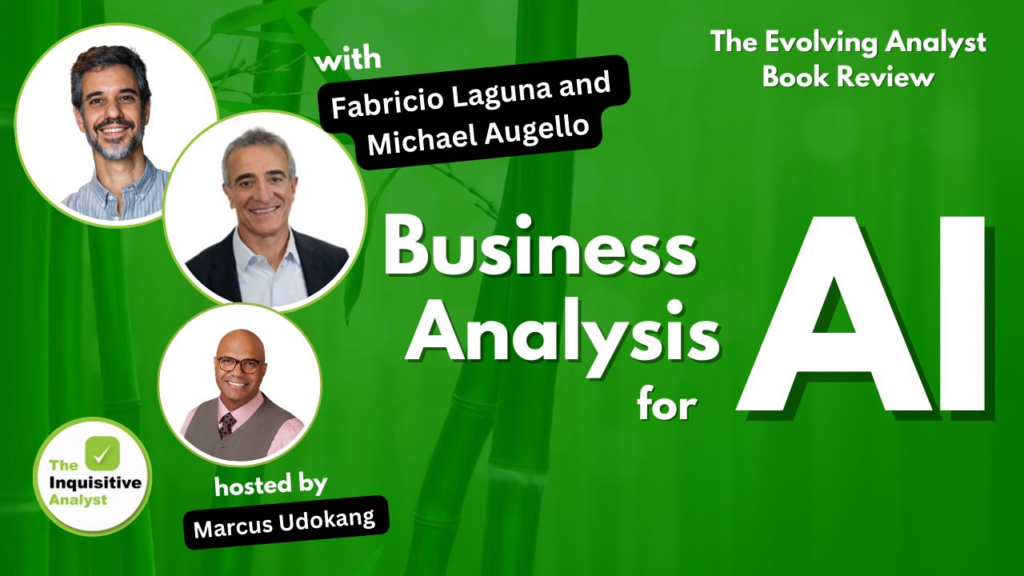
In an insightful conversation with host Marcus Udokang on The Inquisitive Analyst, business analysis thought leaders Fabricio Laguna and Michael Augello explored this challenge through their chapter, “Business Analysis for AI”, featured in The Evolving Analyst.
Their message is clear: AI may accelerate delivery, but business analysis remains essential for creating meaningful outcomes.
AI Is Not the Goal
One of the most thought-provoking observations from Fabricio Laguna is deceptively simple:
“Nobody needs AI.”
While AI can generate content, create prototypes, analyze data, and automate tasks, organizations do not adopt AI for its own sake. They adopt it because they believe it can help solve business problems, improve customer experiences, reduce costs, or create new opportunities.
This distinction is crucial.
Before selecting an AI solution, organizations must first understand:
- What business problem are they trying to solve?
- Who are the stakeholders involved?
- What outcomes define success?
- Which metrics will demonstrate value?
These are fundamental business analysis questions.
According to Laguna, AI should be viewed as a component of a broader solution rather than the solution itself. The role of the business analyst is to ensure that technology remains aligned with business objectives and stakeholder needs.
The Value of Challenging Assumptions
Michael Augello highlighted another critical responsibility of analysts: validating assumptions.
Organizations frequently operate based on beliefs that are accepted as facts. Yet many of these assumptions have never been challenged.
One example Augello shared involved system upgrades and organizational reporting. During transformation initiatives, teams often assume that every existing report must be preserved. However, when analysts investigate how reports are actually used, they often discover that many reports are rarely read or not used at all.
The result?
Organizations can eliminate unnecessary work, reduce costs, and improve efficiency simply by questioning assumptions.
This illustrates a core principle of effective business analysis: value is often created not by adding more detail but by asking better questions.
Outcomes Over Outputs
A recurring theme throughout the discussion was the distinction between outputs and outcomes.
Many organizations measure progress through deliverables:
- Requirements documents
- Specifications
- User stories
- Process maps
- Reports
While these artifacts can be valuable, they are not the ultimate goal.
Laguna argues that analysts must resist becoming “output creators” and instead focus on becoming “outcome generators.”
A specification, for example, has little intrinsic value. Its value comes from its ability to support a business objective.
Successful analysts continually ask:
- What are we trying to achieve?
- How does this activity contribute to the desired outcome?
- Are we creating value for stakeholders?
Maintaining this perspective helps prevent teams from becoming trapped in process compliance while losing sight of business goals.

Find out more about the outcome-driven mindset by reading Please Hold – The Power of Outcome-Driven Thinking, a fun business novel for anyone driving real change at work and beyond.
Frameworks Are Guides, Not Constraints
Methodologies, frameworks, and structured approaches provide valuable guidance. Whether organizations use Agile, Scrum, Kanban, Waterfall, or hybrid approaches, frameworks help teams organize their work.
However, Laguna cautions against allowing frameworks to limit critical thinking.
As he explains, professionals should use frameworks without becoming controlled by them.
Augello reinforced this point by sharing a personal experience. After successfully applying a reporting structure and engagement approach with one client, he attempted to reuse the same template with another organization. Midway through the engagement, he realized the approach was no longer effective because the context was different.
The lesson was clear: Context always matters more than process.
Effective analysts adapt their methods to fit the situation rather than forcing situations to fit a predefined methodology.
AI Is Accelerating Delivery But Not Decision-Making
Modern AI tools can generate code, create prototypes, draft documentation, and automate many activities that once required significant manual effort.
As these capabilities mature, development cycles continue to shrink.
Yet faster delivery introduces a new challenge: technology is no longer the primary bottleneck. Decision-making is.
Organizations increasingly need people who can:
- Interpret complex situations
- Evaluate options
- Facilitate stakeholder alignment
- Define strategy
- Understand context
- Guide informed decisions
These responsibilities cannot be delegated entirely to AI.
In fact, as technical execution becomes faster, human judgment becomes even more valuable.
Analysts Are Enablers, Not Blockers
One concern often raised in high-speed delivery environments is whether analysis slows progress.
Both Laguna and Augello reject this assumption.
Business analysts should not be viewed as blockers. Instead, they serve as enablers who help organizations make better decisions faster.
AI can dramatically reduce the time required for research, documentation, and prototyping. The opportunity for analysts is to reinvest that saved time into deeper analysis, stronger stakeholder engagement, and more strategic thinking.
Rather than spending hours documenting requirements, analysts can focus on understanding needs, evaluating alternatives, and ensuring alignment between business goals and solution design.
This shift elevates the profession from documentation support to strategic leadership.
The Future of Business Analysis in an AI World
As AI continues reshaping organizations, the role of business analysts is evolving rather than disappearing.
The future analyst is not simply a requirements writer or process documenter. Instead, they are:
- Strategic thinkers
- Sense-makers
- Decision facilitators
- Outcome advocates
- Context interpreters
- Value creators
Technology may automate many tasks, but it cannot replace the human ability to understand organizational dynamics, challenge assumptions, navigate ambiguity, and guide meaningful change.
The organizations that succeed with AI will not necessarily be those that deploy the most sophisticated tools.
They will be the organizations that combine AI capabilities with strong analytical thinking and a relentless focus on business outcomes.
Final Thoughts
The conversation between Fabricio Laguna, Michael Augello, and Marcus Udokang reinforces an important truth: AI changes how work gets done, but it does not change why work gets done.
Business analysis remains the discipline that connects organizational goals, stakeholder needs, and technology solutions.
As AI accelerates delivery, analysts have an opportunity to move beyond documentation and become even stronger contributors to strategy, decision-making, and value creation.
The future belongs not to those who simply implement AI, but to those who use it thoughtfully to solve real business problems.
Watch the Full Conversation
Business Analysis for AI: with Fabricio Laguna & Michael Augello | The Inquisitive Analyst
Connect with the Speakers on LinkedIn
- Senior Business Analyst
- Business Analyst Mentor & Career Strategist
- Co-compiler of ‘The Evolving Analyst’ book
- Author of Please Hold: The Power of Outcome-Driven Thinking
- Senior Advisor, IIBA
- Educator and Business Analysis Thought Leader
- Founder, OptimizU
- Strategic Advisor, IIBA
- Business Analysis and Transformation Specialist
References
- The Evolving Analyst (Book)
- Business Analysis for AI by Fabricio Laguna and Michael Augello
- The Inquisitive Analyst Podcast hosted by Marcus Udokang