
Three years ago, I published a video depicting a futuristic scenario in which a business analyst worked alongside an artificial intelligence assistant using a conversational interface with graphical resources to understand trends, analyze indicators, evaluate scenarios, run experiments, and make decisions that automatically modified business rules and organizational processes.
In the post accompanying the video, I challenged viewers with a very simple question:
What year will this happen?
If you haven’t seen that video yet, you might want to watch it before continuing. It’s worth it! It’s only six and a half minutes long and portrays one possible future.
After watching it, make your own judgment: was I completely out of my mind with an impossible scenario, or was I simply showing, slightly ahead of time, a glimpse of what was already beginning to take shape?
What People Thought Back Then
I published that video on LinkedIn and YouTube in June 2023. Some people commented that this future was practically here already and that businesses would be working this way before the end of that same year. Others believed it would take at least a decade. And some thought it would never happen.

Three years later, I still feel that the year 20XX has not yet arrived, and the question remains just as relevant:
What year do you think this will become reality?
Pointing to the Future as a Target, Not as a Crystal Ball
Some people may interpret that video as an attempt to predict the future, but that was never my intention. As a business analyst, my job is not to predict the future. It is to help design it.
Business analysts like me specify solutions before they exist. We create models, prototypes, and scenarios that guide those who will eventually build them. That’s exactly what I tried to do with that video.
More than imagining how artificial intelligence would evolve, I wanted to illustrate a possible future. One that could inspire developers, organizations, and investors to build the tools needed to turn it from fiction into reality.
This article serves the same purpose. But this time, by looking at what has evolved over the past three years, what has yet to arrive, and what has actually gotten worse.
What Has Evolved
Looking back at that video today, it’s impressive to see how much some of these technologies have evolved in just three years.
Natural Language Interfaces
At the time, I used a few editing tricks to simulate a natural conversation between the business analyst and the artificial intelligence assistant. Today, that’s become commonplace.
Talking to an AI by voice, interrupting it while it’s responding, sharing images, using multimodal interaction, and communicating almost in real time are now part of the experience offered by many commercial tools.
We’re still a long way from seeing this interface replace every corporate system, but it seems increasingly clear to me that this will become the primary interaction model between people and technology over the coming years.
The technology to make this happen already exists, and it’s remarkably reliable.
Agentic AI
Back in 2023, most AI applications behaved like chatbots: they answered questions.
Today, we’re entering the era of AI agents. AI systems are now able to pursue goals, define strategies, execute plans, use tools, integrate with enterprise systems, and call APIs to perform real-world activities.
A significant portion of today’s corporate AI investments is moving in exactly this direction.
Shared Corporate Knowledge
Another important evolution has been the way organizations connect their knowledge bases to AI.
Instead of relying solely on what the model learned during training, companies are enabling their AI assistants to consult documents, policies, business processes, structured databases, meeting notes, and internal information to answer questions and support decision-making.
Corporate copilots represent a major step in this direction and are already beginning to resemble the scenario presented in my original video.
AI-Assisted Work
We’ve also made tremendous progress in the way AI supports professionals across many different disciplines.
- Business analysts write requirements, user stories, acceptance criteria, and analyze documentation much faster.
- Developers generate and improve source code.
- Lawyers use AI to read, analyze, and draft legal documents.
- Commercial teams use AI to prepare proposals and contracts.
Rather than replacing these professionals, AI has taken over much of the operational work, freeing them to act more strategically.
At least, that’s the promise.
What Still Hasn’t Arrived
While technology has advanced rapidly, I’ve come to realize that the biggest obstacles are no longer technological. Today, they’re organizational.
A Truly Integrated Business View
In the video, the AI had access to multiple corporate data sources, business indicators, processes, business rules, and transactional data. As a result, it could provide the business analyst with a holistic view of the organization to support decision-making.
That scenario is still rare.
Not because the technology doesn’t exist, but because very few organizations have data that is sufficiently integrated, documented, and trustworthy to enable this kind of capability.
There is still an enormous amount of work to be done in data integration, data quality, process documentation, and making business rules explicit before we can provide AI with the context it needs to act as a true corporate copilot.
Dynamically Reconfigurable Businesses
Another area that has seen very little progress is the ability to modify business rules and processes through configuration alone, without going through a software development cycle.
In the video, the AI identified opportunities for improvement, proposed changes, submitted them through the appropriate governance workflow, and, once approved, deployed them into production with virtually no human intervention.
Although today’s technologies can automate much of this flow, I still see very few organizations prepared to delegate this level of responsibility to AI.
The limitation is no longer technical. It has become a challenge of governance and organizational design.
What Has Gotten Worse
There is, however, one aspect in which I believe we’ve moved in exactly the opposite direction from what I envisioned in the video.
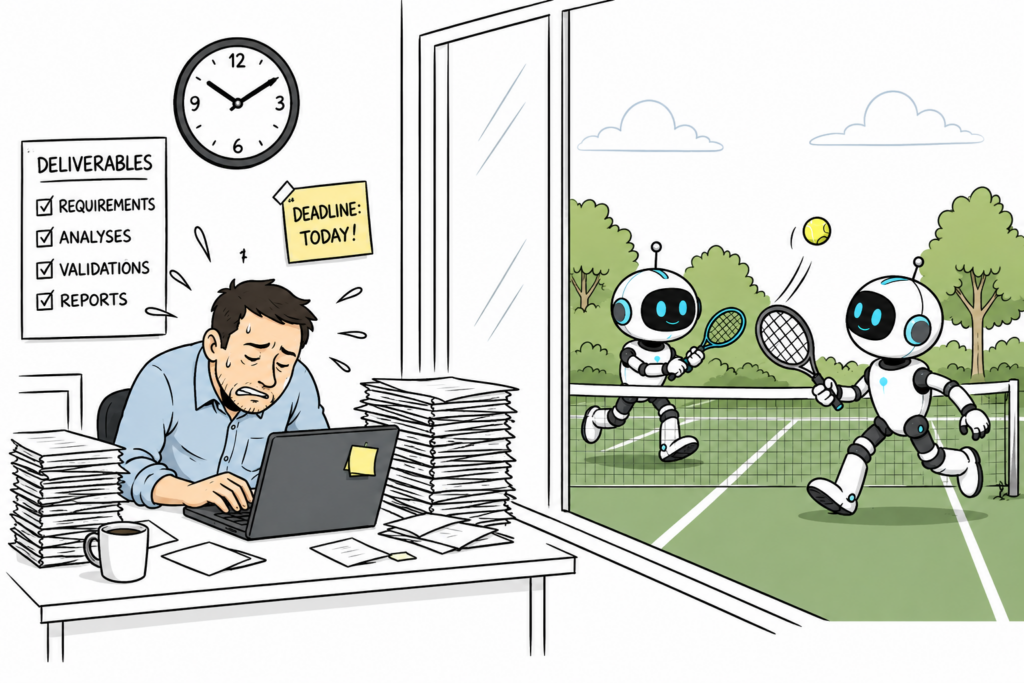
According to my friend Vince Mirabelli, the most important detail in that video wasn’t the artificial intelligence itself. It was the tennis court.
He loved the fact that, after completing virtually an entire day’s work in about five minutes, I simply shut down my computer and went to play tennis. He understood that not merely as a playful way of illustrating productivity gains, but as a much deeper message.
Artificial intelligence should give us back time. Time to:
- reflect;
- learn;
- create;
- spend with our families;
- take care of our health;
- live.
Unfortunately, I believe we’re moving in the opposite direction.
As AI increases our productivity, expectations rise at exactly the same pace. In a matter of seconds, AI produces documents and performs analyses that used to take days. But the time we save never comes back to us. It is immediately filled with new demands.
In most organizations, productivity gains have been treated as an opportunity to accelerate delivery or reduce costs. Not to improve people’s quality of life.
Is this really the future we want to build?
Conclusion
Looking back at that video today, my impression is that technology has evolved faster than we have.
Three years later, technological limitations have almost disappeared. The greatest challenge is now organizational.
Today we have smarter models, more natural interfaces, more capable agents, and much more mature tools, but we still need to improve the integration of knowledge bases, process governance, the ability to adapt businesses dynamically, and, above all, the way we choose to use all this technology.
Watching that video again today, I feel the need to reformulate my original question about when the year 20XX will arrive. The more relevant question is: What future do we want to build?
Progress is not only about technology. It’s also about quality of life.
How can we use artificial intelligence to free people from excessive work so they can devote more time to thinking, creativity, relationships, and the things that truly matter?
We need to discuss not only what AI is capable of doing, but also the outcomes we expect it to deliver for organizations, society, and the environment.
I hope to revisit that video again in another three years. And more than finding even more advanced technologies, I hope to find organizations and people who have evolved in the same direction.
May that prototype continue to inspire future tennis players.
And you? What future do you hope technology will help us achieve? And what role do you intend to play in building that future?
References
Articles Exploring the AI Frontier
- Future of BA with AI
- Pioneering AI Frontier: Unleashing Natural Language Interface
- Pioneering AI Frontier: Integrated Knowledge Bases
- Pioneering AI Frontier: Dynamically Reconfigured Business

Most recent articles related to this topic
- BA4AI – Business Analysis for Artificial Intelligence
- FABR Framework: A Guide to Lead AI Adoption with Safety and Value
- Beyond Headcount: Rethinking Artificial Intelligence ROI
- Jairo’s New Assistant
Comment on this article on LinkedIn.