How job titles, roles, and competencies relate to your profession
Read this article in Portuguese
I’ve been talking to many professionals and organizations, trying to understand how career progression works in companies where highly intellectual work is performed, and it seems to me that the game has changed.
For a long time, we were taught to think of a career as a ladder: you start at the bottom, learn, gain experience, get promoted, and move up one step.
Then another. And another.
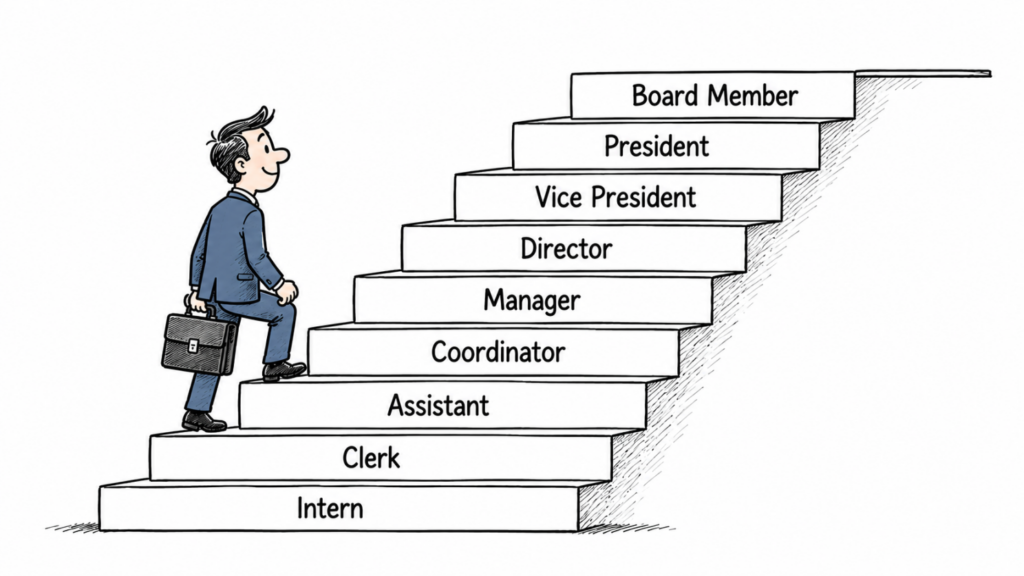
Each new step brings greater responsibilities and more complex tasks. The higher you manage to climb that ladder, the more successful you are. But that ladder is becoming increasingly difficult to find.
Organizations are forced to change continuously. People are allocated to projects. Teams are formed and disbanded. New technologies and new methods turn structures upside down. Responsibilities cross departmental boundaries. People lead one initiative and contribute to another as specialists.
The ladder metaphor no longer seems to fit the dynamics of career development. So I’d like to propose a different analogy: a chessboard.
Chess is not a hierarchy
In a game of chess, nobody starts as a pawn hoping to become a king. That’s not how the game works. Each piece contributes to the strategy by occupying different squares on the board.
Although chess pieces were inspired by the medieval monarchical structure, they do not represent a hierarchy. They represent different movement capabilities.
- The pawn moves forward and captures diagonally.
- The bishop moves diagonally.
- The rook moves along ranks and files.
- The knight jumps over other pieces in an L-shaped move.
- The king can move in any direction, but only one square at a time.
- The queen combines the movement capabilities of the rook and the bishop.
In my metaphor, you are one of the pieces. Your competencies determine the moves you are capable of making and, consequently, the positions you can take on the board.
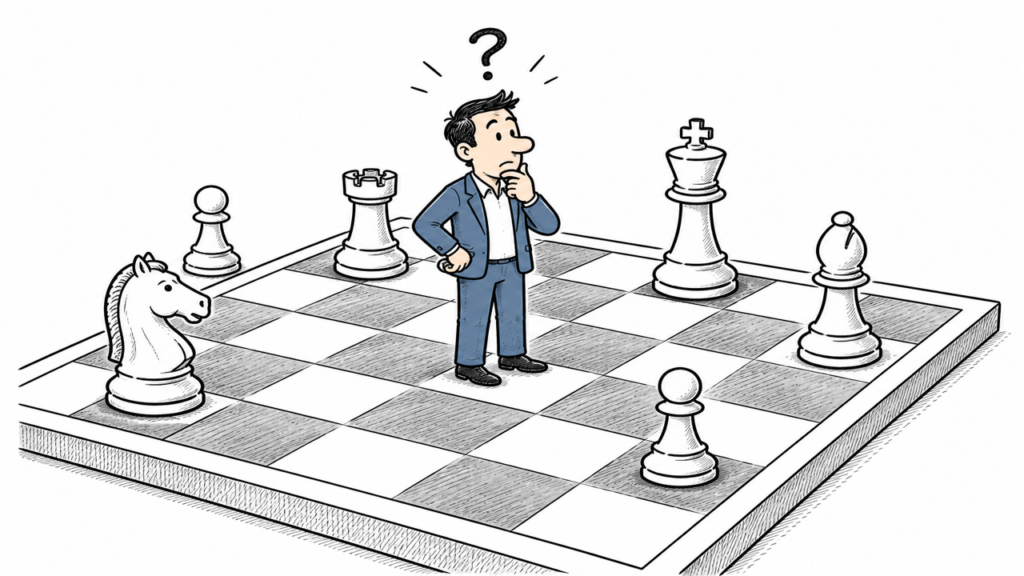
From the ladder to the chessboard
Imagine each square on the board representing a role that needs to be performed in the organization.
- Team Leader;
- Product Owner;
- Planner;
- Tech Lead;
- Facilitator;
- Business Domain Expert;
- Quality Assessor;
- Key User;
- Mentor.
Or any other role defined by your way of working.
Moving from one role to another does not necessarily mean that the professional has been promoted or demoted. It simply means that they will contribute to the strategy in a different way.
Thinking about careers this way requires us to separate a few concepts.
Job titles, roles, and competencies
This distinction seems rather blurred in Human Resources Management.
Is “Senior Business Analyst” a job title, a role, or a set of competencies?
Ask that question in three organizations, and you’ll probably get four different answers. These concepts are usually mixed together.
I propose the following distinction. (I know it may not be universally accepted, and I’m open to other perspectives. Share yours in the comments):
- Job title is a formal position within the organizational structure, usually associated with an employment contract that establishes compensation, benefits, and relatively stable responsibilities.
- Role is a set of responsibilities assumed by someone in a specific context. Note: your role may change without your job title changing.
- Competency is the ability to mobilize knowledge, skills, and experience to act effectively in a given context.
Your career can evolve across all three of these dimensions, but not necessarily in a linear way.
A person hired under a particular job title may perform different roles in different initiatives. They may lead in one situation and be led in another. They may be the expert in one project and the learner in the next.
And that is not necessarily an organizational inconsistency. It may be part of a strategy to make the organization more adaptable. More nimble.
Back to the chessboard
You are a piece, and you can move around the board, occupying different positions.
Each position is a role that defines responsibilities associated with a specific context.
Your competencies determine the moves you are capable of making. Combine that with your context (your current position), and you can determine which positions you may be able to take.

Your job title is not part of this chessboard. It is an administrative classification that evolves in another game, where salary, benefits, seniority, contractual responsibilities, and other administrative matters are established. That evolution is related to your performance in the roles you take on, but it deserves a separate analogy that I’m not addressing in this article.
My apologies. I imagine that’s the game you’re most interested in.
Over time, you expect to earn more and climb the Junior, Mid-Level, and Senior steps until you reach the next stage of the little salary game. But your job title says less and less about what you actually do every day. The description of your real work tends to be much more volatile.
Despite your frustration, I hope this analogy can raise some interesting questions about how you define yourself professionally.
The concept of profession
In the past, it was common to give a single name to all three of these concepts. A profession was a blend of job title, role, and set of competencies.
So, when hiring a Business Analyst, Requirements Engineer, or Business Architect (just to name a few professions), the organization expected to bring in someone with a certain competency profile, pay a certain salary level, and have that person produce a particular set of deliverables.
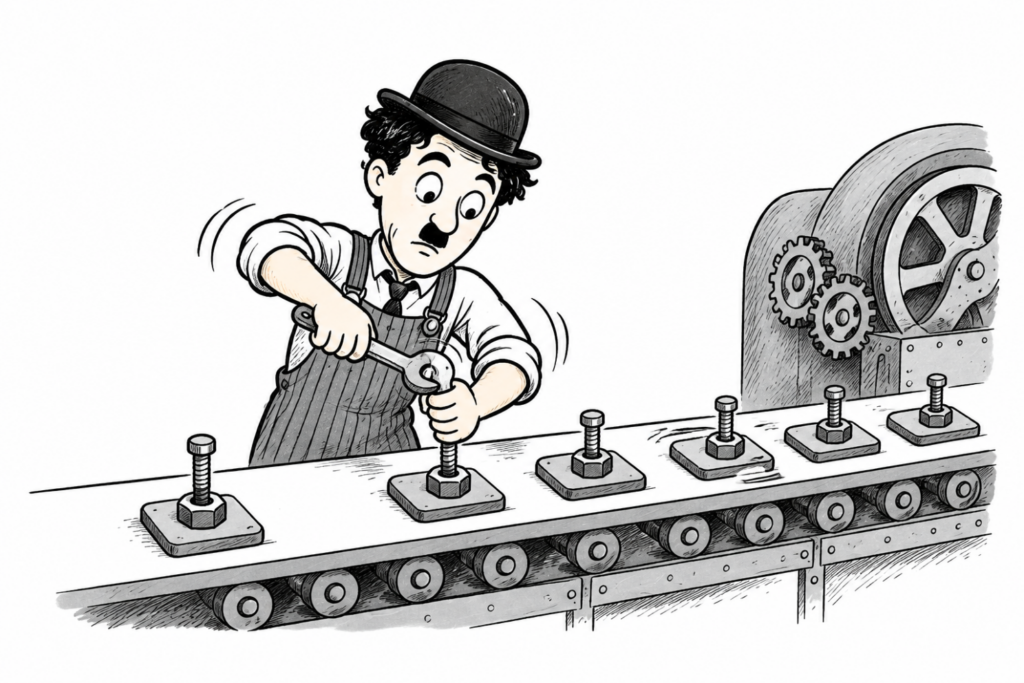
This model has been dissolving over the past few decades. The assembly line with Charles Chaplin tightening bolts is not a reality that applies to the knowledge industry.
More agile ways of working have popularized multidisciplinary and self-managed teams. Employers expect professionals to apply their competencies flexibly, identifying what needs to be done and responding in the most appropriate way, regardless of a predefined script or rigid boundaries around their area of responsibility.
The expected commitment is not only to outputs, but to outcomes.
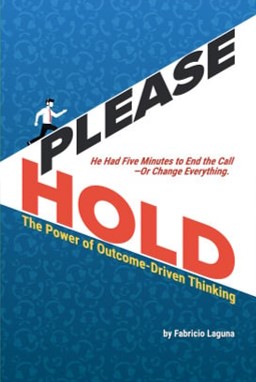
Find out more about the outcome-driven mindset by reading Please Hold – The Power of Outcome-Driven Thinking, a fun business novel for anyone driving real change at work and beyond.
The impact of AI on the job market is accelerating this shift even further. If professionals were once defined by their deliverables, that way of defining their value starts to make less sense when AI begins producing those same deliverables automatically.
A profession should not be reduced to a set of deliverables. AI may reduce the need for people exclusively dedicated to producing certain artifacts, but that does not reduce the need for the competencies behind them.
The role of professional associations
If what we once called a profession (as a package of job title, role, and competencies) is beginning to break apart, professional associations need to rethink their role and reassess how they support their members.
The concept of profession has always been, and continues to be, essential for providing professional identity, learning pathways, professional communities, terminology, standards, codes of ethics, certifications, and so on.
Regardless of the job title or role you are performing, what still seems most strongly connected to a profession is its set of competencies.
And in that sense, you can accumulate them by turning to different associations:
- Look to IREB to develop competencies in Requirements Engineering.
- Look to IIBA to develop competencies in Business Analysis.
- Look to Business Architecture Guild to develop competencies in Business Architecture.
Each of these associations offers guides, certifications, and a community dedicated to advancing knowledge and practices in its area of specialization.
And don’t be surprised if you find people who are active members of more than one of them. These areas are not mutually exclusive. There is considerable overlap, and professionals can combine competencies from different specialties to expand their possibilities for movement.
Developing your career means expanding your possibilities for movement
In today’s work environment, career development depends less on following a predefined path and more on expanding your possibilities for movement. You can develop competencies associated with other professions to take on roles that were previously beyond your reach.
Developing strategic thinking, facilitation, negotiation, analysis, creativity, or business knowledge can completely change the area of the board you are able to reach.
You don’t need to learn everything about every profession. Just as the queen is an extremely powerful piece but still cannot make the knight’s move, you can focus on developing the moves you need to reach the squares where you would like to be.
Different professionals can build different sets of competencies and, consequently, have different possibilities for movement.
What is your next move?
When we think of a career as a ladder, someone needs to build the steps. We expect a career plan, promotion criteria, and a reasonably predictable sequence of job titles. Normally, we expect companies to build that for us. And when they don’t, we feel lost.
On the chessboard, responsibility shifts. The organization can offer opportunities and completely change the configuration of the game. Roles that were available yesterday may disappear; others that did not even exist may emerge. But you need to understand your competencies and the moves they allow you to make.
If you want to take charge of your own career today, don’t limit yourself to asking:
“What is the next step in my profession?”
Instead, reflect on:
“From where I am now, which squares can I move to?”
And if the square I want to reach is still beyond my reach:
“What new move do I need to learn?”
Career development is no longer just about moving up. It is increasingly about understanding where you are, which moves your competencies allow you to make, and which new competencies you need to develop to expand your options on the board.
A picture still taking shape
I’ve been talking to professionals from different companies and associations to better understand the transformations taking place in the world of work, particularly in Business Analysis, which is my area of expertise. This article is an attempt to organize my reflections.
I confess that I’m still not entirely convinced by the chess metaphor. While writing this article, I changed the metaphor several times before arriving at this version. Even so, I thought it was already worth sharing so I could get some feedback.
I’ll be happy if you add something in the comments that validates, challenges, or contributes to this analysis.
Acknowledgements
These reflections were also enriched by recent conversations with Susan A. Moore, CBAP, AAC, PMI-PBA, PMI-ACP, Stan Bühne, Kim Lauenroth, Robert Snyder, Thea Soehren, CBAP, CSPO, ICP-APO, Laura Brandenburg, CBAP, Scott Ambler, and Ankit Agrawal.