
In this conversation about Business Analysis Value, I spoke with Erfan Afthab, a business analyst and product professional who has worked across India, the Middle East, the UK, and Australia.
With more than sixteen years of experience, Erfan shared his perspective on how the discipline of business analysis is evolving, especially with the rise of agile ways of working and artificial intelligence.

Watch the other episodes in this podcast series featuring interviews with experts from around the world.
From Requirements to Problem Solving
Erfan’s entry into business analysis began when a manager recognized that he understood systems and user journeys end-to-end. Initially, he resisted the role because he believed business analysis was limited to gathering requirements and documenting them.
However, he soon discovered that the discipline is much broader. At its core, business analysis is about identifying real problems, understanding stakeholders’ pain points, and ensuring that the solutions built truly address those needs.
This perspective led him to a simple definition of the profession’s value.
Business analysis exists to reduce the cost of building the wrong thing.
In a world where organizations can build software faster than ever, the risk of solving the wrong problem has increased. Business analysts play a crucial role in aligning stakeholders, clarifying the problem, and defining requirements that can be validated before development progresses too far.
The Role of Business Analysts in Agile Teams
One recurring debate in the profession is whether business analysts still have a place in agile frameworks such as Scrum, where the role is not explicitly defined.
According to Erfan, this debate often stems from confusion between roles and job titles. Scrum defines roles such as Product Owner or Scrum Master, but it does not dictate the professional background of the person performing them.
A business analyst can often fulfill the responsibilities of a Product Owner because both roles involve:
- Understanding business problems
- Connecting strategy with product direction
- Translating needs into actionable requirements
- Aligning stakeholders and delivery teams
In practice, Erfan believes business analysts should be embedded within agile teams and participate actively in daily collaboration. Being close to the development team helps maintain context and ensures that solutions remain aligned with real user needs.
What Changes Across Countries and Organizations
Having worked in multiple regions—including India, the Middle East, the UK, and Australia—Erfan observed that the core skills of business analysis remain consistent worldwide.
The fundamentals include:
- Framing problems clearly
- Aligning stakeholders
- Translating business needs into technical language
What varies between organizations is mainly the methodology used to structure the work. In traditional environments, requirements are documented in detailed business requirement documents (BRDs). In agile contexts, those requirements are typically expressed through user stories and acceptance criteria.
Despite these changes in format, the underlying goal remains the same: ensuring that teams build the right solution.
How AI Is Changing Business Analysis
Artificial intelligence is reshaping business analysis in two distinct ways.
1. AI Supporting Business Analysts (#AI4BA)
First, AI tools are dramatically increasing analyst productivity. Tasks such as drafting user stories, creating documentation, or organizing requirements can now be accelerated using generative AI.
This does not replace the analyst. Instead, the analyst becomes responsible for:
- Providing the right prompts
- Reviewing AI-generated outputs
- Ensuring accuracy and testability
Ultimately, the accountability for the documentation still belongs to the analyst, not the AI.
2. Business Analysis for AI Products (#BA4AI)
The second transformation occurs when analysts work on AI-driven products themselves.
Traditional software behaves deterministically: given the same input, the system produces the same output. Requirements and acceptance criteria can therefore be defined in absolute terms.
AI systems behave differently.
Because AI models often produce probabilistic outputs, analysts must define requirements differently. Instead of absolute rules, they often define:
- Thresholds of acceptable performance
- Accuracy metrics
- Evaluation criteria for “good enough” outcomes
This shift requires analysts to think more like evaluators of model behavior rather than simply defining functional logic.
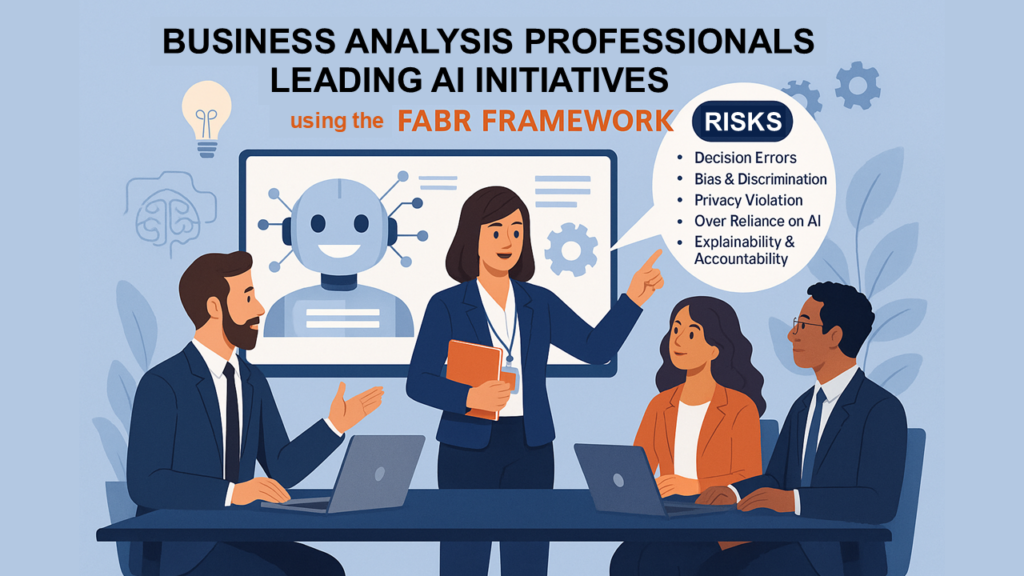
Check out the FABR Framework a practical guide for business analysts to lead AI Transformation
Data Literacy: A New Core Skill
One of the most important capabilities emerging for modern analysts is data literacy.
As organizations become increasingly data-driven, analysts must be comfortable:
- Exploring datasets
- Challenging assumptions with evidence
- Validating whether requirements match real-world behavior
This skill is especially important when working with AI systems, where understanding data quality and model behavior becomes essential to defining meaningful requirements.
In many ways, the role of the business analyst is expanding, adding new layers of competence rather than replacing traditional skills.
The Future of Business Analysis
The conversation with Erfan highlights an important message: business analysis is not disappearing. Instead, it is evolving.
While tools, methodologies, and technologies continue to change, the fundamental need remains the same: organizations need people who can understand problems deeply and ensure that the solutions being built truly create value.
As software development becomes faster and AI becomes more powerful, the importance of Business Analysis Value may actually increase as the cost of building the wrong thing becomes even higher.

Acknowledgment

I want to thank the International Institute of Business Analysis for supporting this initiative.
As part of the IIBA community and serving as Senior Advisor to the President & CEO, it’s a privilege to help bring forward the voices of practitioners shaping our profession.
References
- Connect with Erfan Afthab on LinkedIn
- Listen to this and other episodes on The Brazilian BA Guest on Spotify
- Read the summary and watch other episodes of The Brazilian BA Guests on the Current State of Business Analysis
- Connect with the global Business Analysis community at iiba.org