
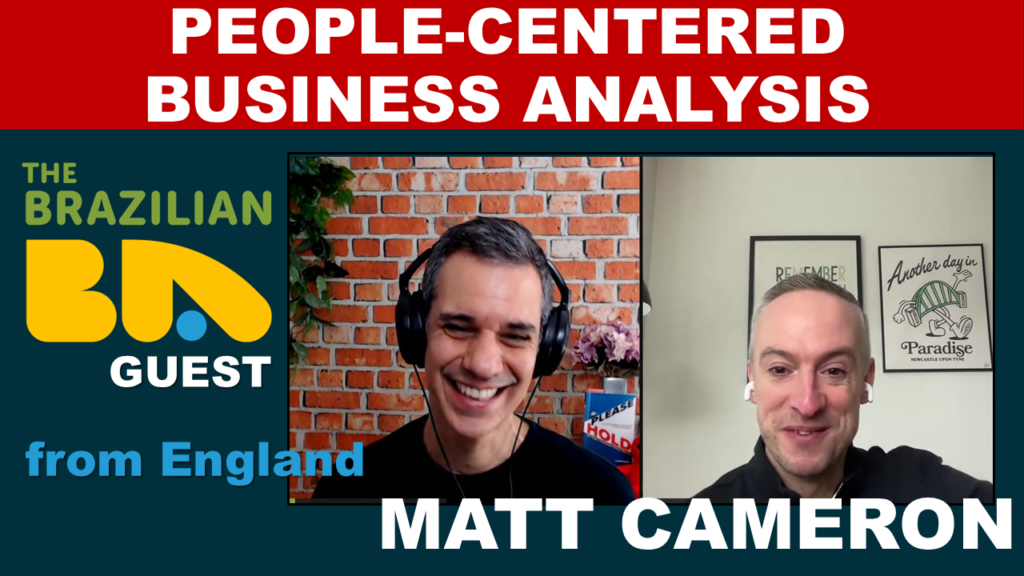
In this episode of The Brazilian BA Guest, Matt Cameron shares his perspective on People-Centered Business Analysis and how the profession is evolving in response to organizational change, new technologies, and the growing influence of artificial intelligence.
Drawing on nearly two decades of experience across the private sector, public sector, and charities, Matt reflects on what truly defines the value of a business analyst today.

Watch the other episodes in this podcast series featuring interviews with experts from around the world.
From Continuous Improvement to Business Analysis
Matt Cameron’s journey into BA began “By Accident”. Starting his career as a technical administrative assistant in a multinational engineering company, he became deeply interested in Lean Six Sigma and continuous improvement. That curiosity eventually introduced him to the role of a business analyst.
Rather than following a predefined career path, Matt discovered the profession organically. This reflects a common story among experienced analysts: many professionals initially arrive in business analysis through roles in operations, IT, or process improvement before recognizing the broader value of the discipline.
Today, however, Matt observes an important shift: more people are intentionally choosing business analysis as a career, entering through apprenticeships, junior roles, and structured development programs.
The Real Value of Business Analysis
For Matt, the essence of People-Centered Business Analysis lies in understanding people and their frustrations in daily work.
He describes his job in simple terms: working with people to understand the challenges they face and identifying ways to improve how work gets done. Those performing the work often already know what is broken and may even have ideas for improvement. The analyst’s role is to bring together different perspectives across the organization and build a holistic view of the problem.
This approach highlights two critical dimensions of business analysis:
- Understanding human frustrations and motivations
- Seeing the organization as a connected system
By combining these perspectives, analysts can help organizations implement meaningful improvements rather than superficial fixes.
Change Happens With People, Not To People
Another key theme Matt emphasizes is the relationship between business analysis and change management.
When organizations introduce new systems, processes, or structures, success depends heavily on whether people understand and believe in the reasons for change. If change is imposed without explanation or empathy, resistance becomes inevitable.
Business analysts play a critical role in bridging this gap by:
- Explaining why change is necessary
- Connecting business goals with individual concerns
- Helping people see how they benefit from new solutions
In this sense, analysts often act as facilitators and translators between strategy and everyday work.
Outputs vs. Outcomes: The True Measure of Success
Matt also highlights a fundamental distinction that often defines the maturity of business analysis: outputs versus outcomes.
Many stakeholders still view analysts primarily as producers of deliverables such as:
- Requirements documentation
- Process maps
- User stories or tickets
- Future state models
While these artifacts are important, Matt argues that strong analysts focus on outcomes rather than outputs.
Outputs are the documents or artifacts produced during analysis. Outcomes, on the other hand, are the business improvements those artifacts enable — such as better collaboration, improved performance, or more effective decision-making.
This shift from deliverables to real impact is central to the evolution of modern business analysis.

Find out more about the outcome-driven mindset by reading Please Hold – The Power of Outcome-Driven Thinking, a fun business novel for anyone driving real change at work and beyond.
How AI Is Changing the Role of the Business Analyst
Artificial intelligence is another major factor shaping the future of People-Centered Business Analysis.
Tools such as Copilot, Claude, and Gemini can already automate many tasks traditionally performed by analysts. For example, AI can quickly summarize workshop notes, generate documentation, or organize large volumes of information.
Rather than replacing analysts, Matt believes AI will amplify the human side of the role.
If AI can produce outputs faster, analysts gain more time to focus on:
- Stakeholder relationships
- Understanding organizational dynamics
- Facilitating conversations
- Driving meaningful outcomes
In other words, AI increases the importance of human insight, empathy, and collaboration — the very capabilities that define great analysts.
What Makes a Great Senior Business Analyst?
As a consultant and leader who coaches analysts, Matt identifies several qualities that distinguish strong professionals in the field.
Work Ethic
Talent alone is not enough. Successful analysts demonstrate consistent effort and commitment to understanding problems deeply.
Emotional Intelligence
The ability to read people, understand motivations, and adapt communication styles is essential. Analysts must be comfortable speaking with frontline workers and senior executives alike.
Curiosity and Improvement Mindset
Great analysts are naturally curious. They constantly seek to improve processes, systems, and outcomes.
People Skills Over Certifications
While professional certifications and frameworks are valuable, Matt places far greater importance on interpersonal capabilities. Tools and techniques can be learned, but the mindset and empathy required for effective analysis are much harder to develop.
A Mindset More Than a Job Title
Matt and Fabricio see business analysis not simply as a role but as a mindset.
Many professionals may perform the tasks of analysis without holding the official title. Conversely, some individuals may carry the title but lack the underlying mindset that drives meaningful improvement.
A true analyst continuously asks:
- What problem are we really trying to solve?
- Who is affected by this change?
- How can we improve outcomes for both people and the organization?
This mindset ensures that business analysis remains relevant even as technologies and methodologies evolve.
Acknowledgment
I want to thank the International Institute of Business Analysis for supporting this initiative.
As part of the IIBA community and serving as Senior Advisor to the President & CEO, it’s a privilege to help bring forward the voices of practitioners shaping our profession.
References
- Connect with Matt Cameron on LinkedIn
- Listen to this and other episodes on The Brazilian BA Guest on Spotify
- Read the summary and watch other episodes of The Brazilian BA Guests on the Current State of Business Analysis
- Connect with the global Business Analysis community at iiba.org