This article is also available in Portuguese here.
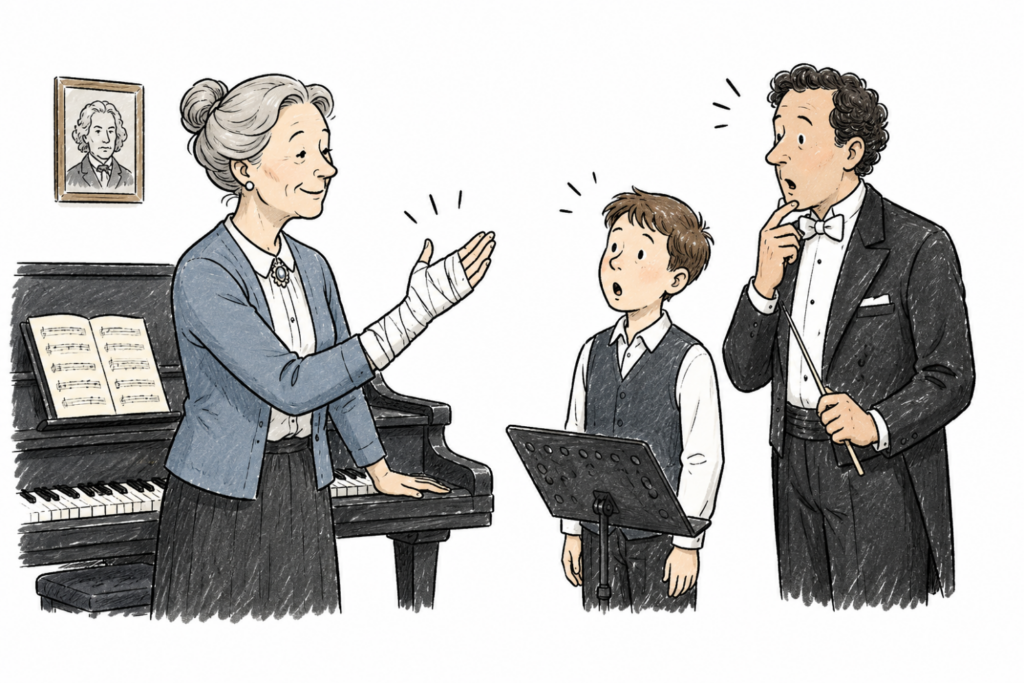
One of my mother’s aunts was a piano teacher for decades. During that time, she had many students who adored her.
One day, one of them said he would like to visit her, accompanied by a relative who happened to be a famous orchestra conductor.
She panicked.
Surely the student would ask her to play something, and the conductor might notice flaws in her performance that could tarnish her reputation forever. If she refused to play, it would seem rude and would be taken as proof that she wasn’t capable.
How could she escape such a disastrous situation?
On the day of the visit, the student and the conductor arrived right on time. My aunt welcomed them with fresh coffee, homemade cake, a warm smile…
…and her right hand completely wrapped in bandages. She had suffered a “supposed” household accident.
My aunt experienced a crisis of self-confidence. The most interesting part is that she was an excellent piano teacher and a very skilled pianist.
The word confidence can represent a feeling toward something, someone, or an organization, but it is more commonly used, just as in my aunt’s story, in a reflective sense, representing the inner certainty a person feels when facing a challenge and believing they will be able to achieve the expected result.
The Importance of Self-Confidence
When an organization like the IIBA adopts the theme “Enabling Confidence”, I understand it is offering solutions for Business Analysis professionals to become more confident that they can help their organizations achieve better outcomes.
Those IIBA solutions include publications, communities, conferences, and learning activities that help transform members into more self-confident professionals.
A self-confident person believes they will succeed, and that belief influences their behavior, increasing their chances of actually succeeding.
- A salesperson is convinced their product is the best on the market and that the customer will be delighted with the purchase.
- A basketball player sees the ball going through the hoop before even taking the shot.
- A comedian pauses after delivering a punchline, expecting the audience to laugh.
- A circus knife thrower launches a sharp blade toward the assistant, fully convinced it will hit the balloon. Not the poor girl’s head.
In every one of these situations, even the slightest sign of doubt or hesitation can ruin everything.
Confidence is not merely desirable. It is essential.
It allows your mind to stay focused and your body to perform like a perfectly tuned machine, doing exactly what it was meant to do.
So that you adopt the right posture.
So that you do what needs to be done, the right way.
Without hesitation.
Lack of Self-Confidence Is Self-Sabotage
A lack of confidence hinders performance.
Uncertainty distracts the mind from its objective, tightens the muscles, delays movements until they lose precision. It shows itself in eyes fixed on the ground, in biting lips, or in an awkward smile trying to hide the embarrassment of a failure that has already been accepted before the game has even begun.
Without confidence, a person may never even step onto the field.
“Whether you think you can, or you think you can’t, either way you are right.” (Henry Ford)
However, one common mistake is to believe that self-confidence is built upon a history of success.
In reality, it has much more to do with the courage to try even when failure seems highly likely.
Self-confidence is not born from the absence of failure.
It stems from the courage to act despite the possibility of failure.
It is through the courage to overcome fear and move forward that self-confidence reveals itself.
There is no courage without fear. Someone who feels no fear is not courageous. Someone who faces danger without fear may simply be reckless or poorly informed. Courage is the willingness to move forward despite fear.
Self-confidence does not eliminate fear. It simply believes that it will be possible to deal with whatever comes next.
Self-Confidence vs. Self-Esteem
Don’t confuse self-confidence with self-esteem.
While self-confidence looks ahead and believes it will succeed in what it is about to do, despite the difficulties, self-esteem looks back and takes pride in past achievements and in the image it has built over a lifetime.
Protecting our self-esteem can actually get in the way of our self-confidence.
The fear of damaging an already established image often prevents us from taking actions that could put that image at risk.
Just like my aunt lacked the courage to play the piano for the conductor, someone with high self-esteem may avoid making mistakes more intensely than someone who has never tried before and feels they have nothing to lose.
Pride can become a barrier to action.
And self-confidence, although it is an inner feeling, only reveals itself through action.
Just as courage only becomes visible when we face fear, self-confidence becomes visible when we act believing that we are capable of meeting the challenge.
Looking Confident Helps You Become Confident
Many confidence-building guides recommend making visible external changes that influence how others see you and how you see yourself.
The motto is:
Fake it till you make it.
Pretending to be confident when you are not is not hypocrisy or a lack of integrity. It is a strategy for overcoming fear.
Your tone of voice and your body language have a two-way relationship with your emotions.
Imagine someone standing in front of an aggressor: shoulders hunched, muscles tense, arms pulled in close to the body, eyes looking down.
Now imagine the opposite: Standing upright. Shoulders relaxed. Arms open. Looking the other person straight in the eye.
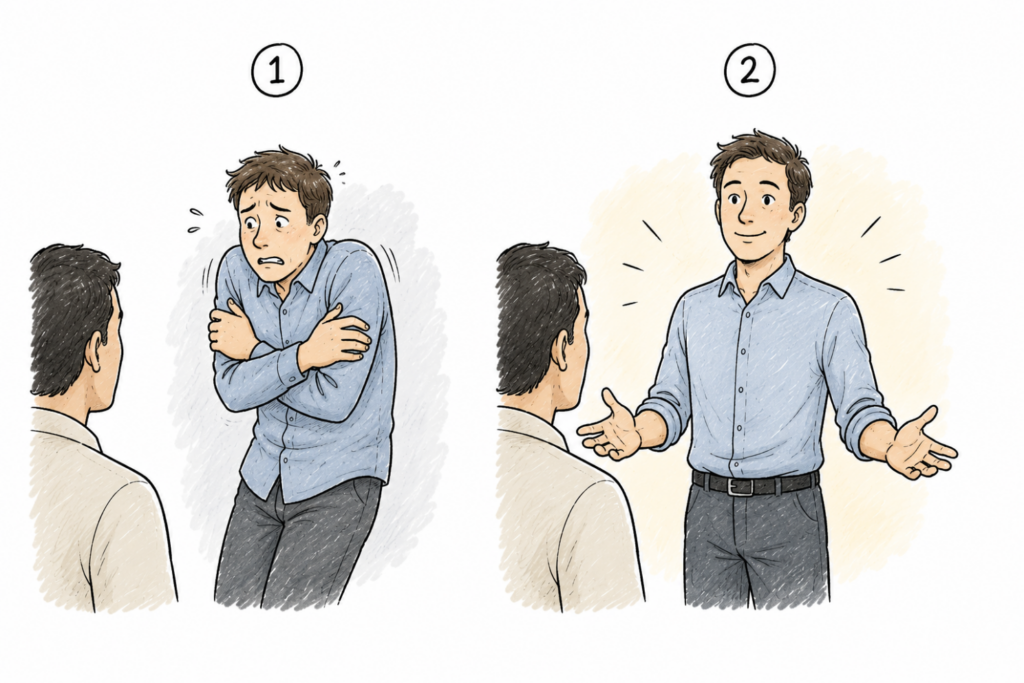
Regardless of the scientific debate surrounding the hormonal effects of so-called power poses, few people would deny that posture, tone of voice, and body language influence how we are perceived and even how we perceive ourselves.
Facing an opponent with your head held high and an expression of confidence commands respect from others and helps calm the trembling in your own legs.
The Apparent Confidence of AI
Although AI is not capable of feeling anything, modern language models are remarkably good at simulating the language of self-confidence.
Whether the information is correct or nothing more than a hallucination, AI communicates with such grammatical accuracy and polished language that almost every answer sounds absolutely right.
This is what we call assertive communication.
Many people mistakenly think that being assertive means being correct. It doesn’t. Assertiveness is not about factual accuracy. It is about communicating with clarity, confidence, and conviction, giving the listener a sense of certainty.
That can be very misleading.
Many times an AI-generated answer is wrong, unverified, or simply the product of a hallucination. Yet the way it is presented is so confident that we tend to believe it without properly validating the information.
It is a perfect example of “fake it till you make it.”
The confidence with which AI responds makes us place our trust in it.
See the previous article “Enabling Confidence: Confidence or Trust?” for a better understanding of this difference.
Self-Confidence for Business Analysis professionals
A large part of Business Analysis is about finding solutions to highly complex problems. Problems that have never been solved before and for which nobody even knows where to begin.
That scenario can seem intimidating enough to discourage even the most experienced professionals, people with outstanding résumés, long histories of success, and plenty of medals on the wall.
So how can we have genuine self-confidence when we don’t have the answers?
It may not be as difficult as it seems. Especially if you embrace the role of a Business Analyst.
You will create tremendous value simply by helping everyone involved develop a shared understanding of the problem. Don’t worry so much about having the answers. Concentrate on asking good questions.
Let curiosity be your guide, and treat everything you don’t know yet as an opportunity to bring to the surface (to elicit) the information that will gradually build your collaborative business model.
Be confident that the answers will come at the right time, when the right questions can finally be asked.
In Business Analysis, confidence is not born from certainty. In fact, there are very few certainties. It grows from curiosity, collaboration, and the courage to move forward even when the path ahead is still not completely visible.
Collaboration is at the heart of Business Analysis.
A solution designed together carries greater authority because it is born with the commitment of everyone who helped create it.
Have the humility to recognize that you are not solely responsible for the analysis. Good Business Analysis is co-created. Create and support an environment where everyone can participate effectively.
Recognize that your own knowledge and wisdom are limited, and trust the techniques of Business Analysis and facilitation to help the collective wisdom of the group emerge.
Your self-confidence should not come from believing that you already have all the answers. It should come from believing that you will be able to find them.
And if they haven’t appeared yet…
…perhaps it simply isn’t the end of the story. Keep moving forward. Mistakes and failures are part of the process. They are what allow us to learn, grow, and improve.
That is exactly what my aunt was unable to do on the day the conductor came to visit. And that is exactly what Business Analysts are called to do every single day when they face new, complex, and uncertain challenges.
Self-confidence does not remove uncertainty. It gives us the courage to keep moving forward despite it.
Coming Next
In the previous article of this series, I argued that trust comes from perception, while confidence comes from evidence.
In this article, I wanted to suggest that, when it comes to self-confidence, the most important evidence may not be a history of success, but a history of courage.
I’m continuing to develop these ideas as I prepare my keynote “Enabling Confidence in the AI Era,” which I’ll be presenting at conferences in São Paulo, Warsaw, and Sarajevo.
I’d love your help. Leave a comment if this discussion resonated with you, if you see things differently, or if you completely disagree. I’d genuinely like to hear your perspective.
In the next article, we’ll talk about moments when confidence may become dangerous.
References
- 1st article of this Series: Enabling Confidence [or Trust?]
- IIBA: Enabling Confidence: Preparing Business Analysis Professionals for What’s Next
- What is Business Analysis?